Description
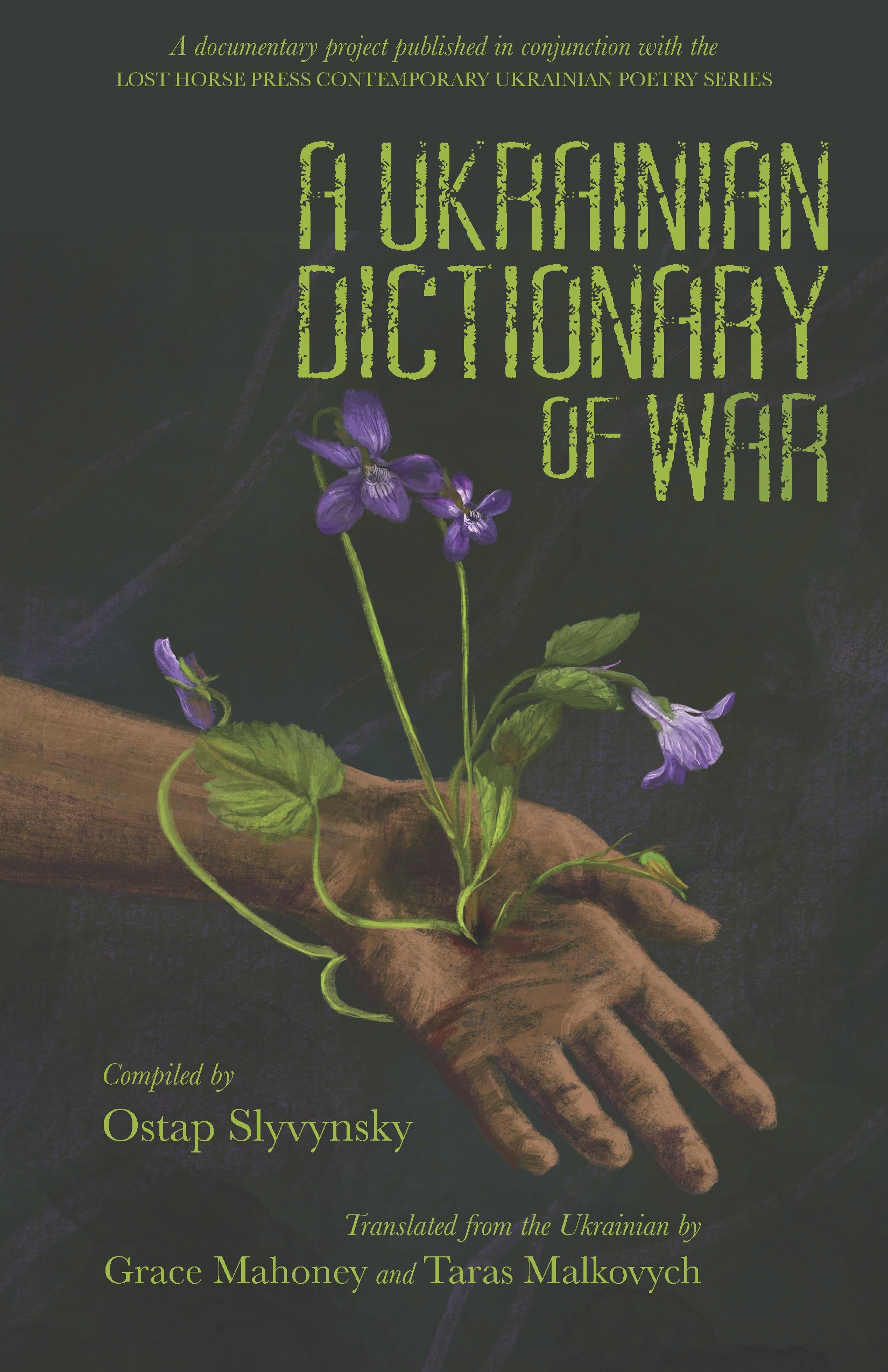
In 2022, poet Ostap Slyvynsky undertook the role of wartime lexicographer, carefully collecting and compiling a dictionary of witness to Russia’s invasion and war against Ukraine. Among the voices represented in A Ukrainian Dictionary of War are those who were forced to leave their homes and venture into the unknown, aid volunteers, medics, social activists, and artists. All very different people connected by the experience that war has appeared in their lives. Presented in a dual-language format, this volume showcases the Ukrainian language and its alphabet. Part of the Russian Federation’s attack on Ukraine is an attack on its language. Despite efforts to the contrary, Ukrainian has grown in recognition and use, which this dictionary further extends to interested readers.
Ostap Slyvynsky initiated and participated in several human rights actions and campaigns in Ukraine, including public actions in support of Oleg Sentsov (2018 – 2019) and Solidarity Words, a campaign in support of Crimean Tatar journalists illegally imprisoned in occupied Crimea and the Russian Federation (since 2021). He was elected Vice President of PEN Ukraine in 2022.
Ostap Slyvynsky is a Ukrainian poet, translator, essayist, and scholar. He is the author of five books of poetry and the editor of three anthologies. Presenting a selection from over a decade of work, Slyvynsky’s Winter King received the Translation Prize from the American Association for Ukrainian Studies, and is shortlisted for the Derek Walcott Prize for Poetry and the National Translation Award in Poetry. His books have been published in Germany, Poland, Czech Republic, Bulgaria, Slovakia, Macedonia, and Japan. He is also known for translating the works of Derek Walcott, William Carlos Williams, Charles Simic, Czesław Miłosz, Olga Tokarczuk, and Georgi Gospodinov, among others.
EXCERPT:
CHERRY PLUM TREE
—Vika, Mariupol
It wasn’t until the tenth day when they started cutting down trees for fuel—and by that point they had already burned everything else that was lying around, like old furniture from the basement, boxes, and crates. But one of our neighbors, an old woman in her eighties, ran out of her house screaming that she wouldn’t allow the cherry plum tree to be harmed. We never even knew it was a cherry plum—the tree never bore fruit. In any case, no one was going to cut it down, it was such a puny thing. But she decided to guard it anyway and stood there until evening.
This was when I still slept at home, even though it was cold at night. And because of this I would wake early. That morning, in the early light, I peered through the window to see her there next to the tree, only lying on the ground. And someone from her house was walking up to check on her. I didn’t ask what happened to her later. I didn’t want to ask. There are some things the heart can no longer take.
Lost Horse Press
$24 / 979-8-9890965-9-6 / Pbk. / 238 pages (OCTOBER 2024)